Home Meet the Blogger Freebies Contact TeachersPayTeachers BlogLovin Instagram Pinterest Facebook Twitter Image Map

October 10, 2022

First Day Lesson Plans for Reading Intervention Groups (Part 2)

Are you curious about how the first days in intervention or pull out groups go?  Make sure you check out post 1, by clicking here.  On the first post I shared what I do on the first day of pull out intervention. Perhaps a quick read through will help you get some ideas of your own....

Day one is all about about building relationships and teaching your new students the routines, procedures and agreements that are in place to maximize your time together. 

Day 2 is a review of the routines, procedures and agreements.  Reviewing and re-teaching expectations is important to keep your year running smoothly.  In fact....beyond the first few days in small group, I still review...especially after a long weekend or a holiday break.
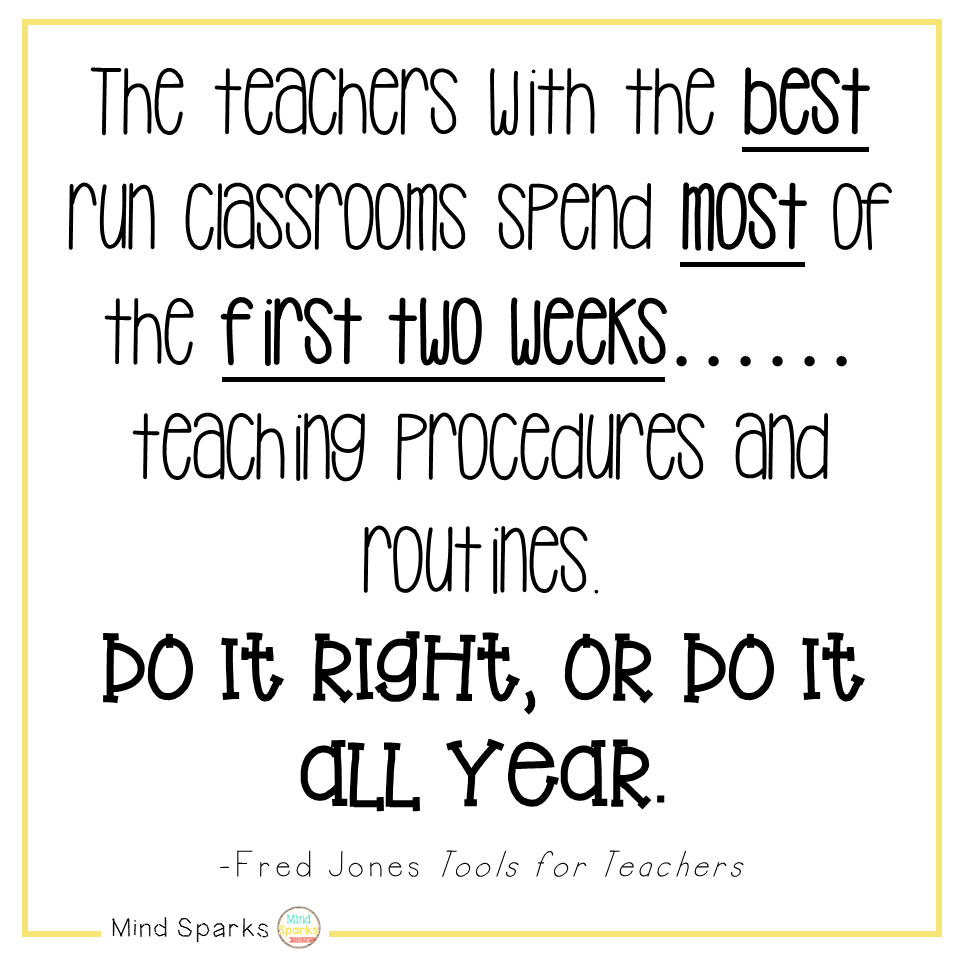

One effective way to review behavior expectations is having students brainstorm what a "ready to learn" student looks and sounds like using a t-chart.   Younger students can draw pictures, or teachers can scribe as students share their answers.  Older students can write bulleted lists with a partner, and then share whole class.  

After the reviewing classroom expectations, I continue to build the culture I want to have in my classroom by reading Our Class is a Family by Shannon Olsen. 

This is a great read to build a sense of community within your small group.  It helps the students learn that our classroom will be a place that is safe to be themselves, make mistakes and be a good friend to others.  


After reading the story, we stop to dialogue about how we are classroom family even though we aren't related.  Students share what makes them special and unique, and we make a commitment to be loving family members. 


Our Class is a Family flows right into making a collaborative class puzzle.  I use the free collaborative class puzzle from TeachEZY on Teachers Pay Teachers.  

I explain that individual puzzle pieces are all beautiful and unique.  Each piece has different shapes, colors, patterns and prints....but it takes ALL of the puzzle pieces to create one stunning, complete image.   The puzzle is just like our classroom family---one complete, amazing picture and the pieces are each of you--wonderfully unique!

Next, each student gets a blank puzzle piece which they decorate to represent themselves.  I love seeing their creativity and passions on paper!


While students are working on their puzzle pieces, I take the opportunity to complete some diagnostic testing.....because small group instruction will be happening the next day! 

What do the first days of your small groups look like? 


September 22, 2022

First Day Lesson Plans for Reading Intervention Groups (Part 1)

Are you curious what the first few days of reading intervention groups look like?

To be honest, the first few days are not a whole lot different than the first days in the classroom.  

The first moments with your new students (whether in small group or the whole class) are all about building relationships and teaching your new students about the routines, procedures and agreements that are in place to maximize your time together. 

It's important for students to know about who they are spending their days with.  Just like we want to know about all of the sweet faces in our room, those sweet faces want to know about us too! So, I always start the first day with a PowerPoint about me. I share slides of my family and favorite things

During the quick presentation, I always stop and ask students to share what they like.  Students might orally share to the whole group, or with a shoulder partner. 


After the presentation, we go over our classroom agreements.  Yep---agreements--not rules.  Rules, according to Merriam Webster, are the laws or regulations prescribed by a founder for observance of its members.  In other words, rules are imposed.  Rules are put into place by someone with power who is "above the people."  They are made for compliance and punishment.

BUT....an agreement is an arrangement that is accepted by all parties.   Agreements are negotiated and set for a purpose of collaboration.  

After thinking about these two terms, I decided I wanted my classroom to be a place where we ALL work together.  I didn't want my classroom to be run like a dictatorship.  So, I changed from rules to agreements. 

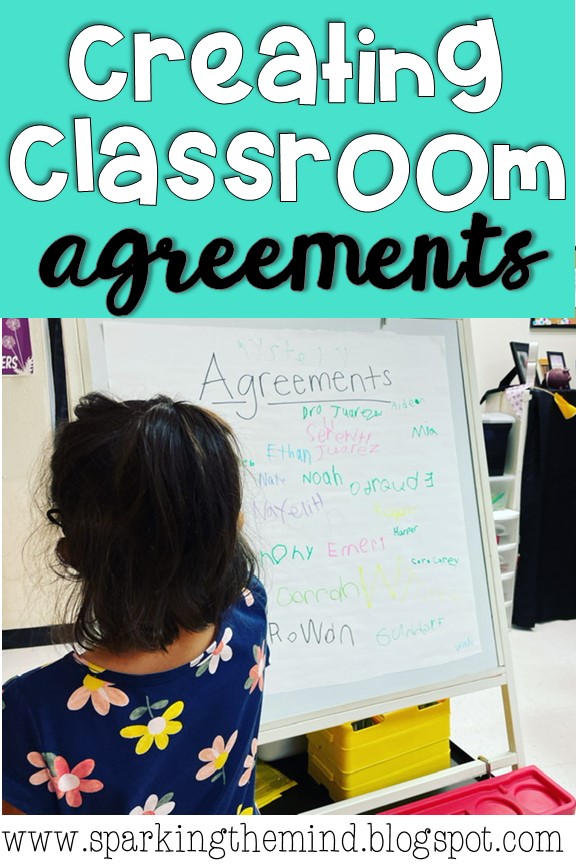
If you want to learn more about how we set classroom agreements, check out this post by clicking here, or the image below. 


Then, we dialogue about what an active listener is. I use this awesome little freebie I found on TPT from Picking Up STEAM with Mrs Owens, where students cut, glue or write all of the characteristics of an active listener.  It is a great visual!

After that, we go over student jobs.  I know small groups have few students in them, but having jobs is crucial for keeping the group running smoothly and sharing responsibility. 

Since my group size runs from two to four students,  I only have four jobs: line leader, door holder, teacher aide and clean up crew. 

Finally, I end the first day of small group by handing out a fun treat! This year I used goldfish crackers, with a tag attached that said this is "oFISHally going to be the best year ever!"


You can get your hands on these treat tags (plus NINE other options) by clicking the image below!  They are great for open houses, back to school nights or the first day of school!


Want to know what Day 2 of reading intervention groups looks like? Come back next week for a peek of what the second day entails!

September 13, 2022

Take Care of YOURSELF! 50 Self Care Ideas for Teachers!

When the back to school season hits, many teachers quickly forget about the importance of taking care of themselves.  

Educators are SO BUSY getting their classroom ready, creating routines, thinking about schedules, new curriculum, old curriculum, standards, data..... All of that back to school brain busyness results in personal care getting put on the back burner.


So, this is just a friendly reminder that it is okay to make yourself a priority

It isn't selfish to love yourself, take care of yourself and make yourself happy.  It is necessary.  

If you are constantly giving your all to everyone and everything, you will eventually burn out.  Your cup will be empty and you will have nothing left to give.


Take a moment and read through the 50 self care actions you can take to nurture yourself.  

Pick your favorites, or try all of them! If it takes you scheduling personal care time on your calendar--then DO IT!  

If you are interested in tips on how to create a plan to keep you mentally healthy this school year, check out the Teacher Self Care.  This post gives four great tips on how to create a self-care plan. 

Another way to stay emotionally aware is by doing to a self-check using Maslow's Hierarchy of Needs Pyramid.  Check out this post which give great reflective questions for each level of Maslow's pyramid.   

Click the image below, where you can download the self care printable.  If you know of someone (spouse, friend, colleague, student) that needs self care--SHARE IT! 


September 1, 2022

The Starfish Story--A Teacher's True Purpose

 Many teachers across the nation are preparing to head back to school in the upcoming weeks, while some have already began their year.  


Once the school year begins, teachers quickly get bogged down with never ending to-do lists, supplies to buy, curriculum to learn, and professional development to attend to.  The list keeps going......  

This overflowing educational plate is all the more reason teachers spend time reflecting on "why" we chose this profession.  

Each year I elect to read (and keep posted in my classroom) a poem adapted from Loren Eiseley's work titled "The Starfish Story."  It is a perfect message for teachers to recall why we do what we do.  

We are here to invest in youth. 

 Invest in our future. 

Often I present professional development to first and second year teachers, and I like to give them this poem as they leave training.  Attached to the poem, I glue a small plastic starfish to serve as a reminder  of our true purpose in education.  

I know all teachers reach point in the school year when teaching seems too hard and they feel as if they are barely keeping their head above water.  My hope is that they will look at that little starfish, and take a moment to refocus and realize the impact they are making. 

If you would like to share "The Starfish Story" with your colleagues, click the first image above or click here to download the poem for free.  

If you are wanting to hand out little starfish--I purchased a 30 pack of of starfish from Amazon for under 10 dollars.  You can find the plastic starfish by clicking here.  


August 19, 2022

Strategies to Ease Anxiety for the New School Year

Are you a worrier?

Do new situations keep you up at night as your brain ponders every possible thing that could happen? 

Do you get the feeling of a pit in the bottom of your stomach when you think about doing something for the first time?

Do your palms get sweaty?  Do you cry? Get angry? Restless? Increased heart rate? Trouble concentrating?  Feeling weak or tired?

All of those are symptoms of anxiety. 


If we feel and experience all of those symptoms as an adult, think about how kids might feel. 

As we approach the upcoming school year, there WILL be kids that are experiencing anxiety.  I know--I have one of them.

The week leading up to kindergarten was rough.  My son cried EVERY morning. He got angry at night. He just wasn't himself.  

So, what can we do to help ease the anxiety and fears of  our students?  The ideas listed below are from personal experience.  Keep in mind I am not a licensed counselor, but they did help my child!


1. Communicate with the teacher

One of the first steps should always be communicating with your child's teacher.  It is highly likely they have experienced similar situations with students in the past, and will be able to provide some strategies to help you and your child get through the first of the year. 

Providing your child's teacher with extra insight will also help the teacher approach your child and the situation differently.  The more teachers know about their students....the better! 


2. Take a picture

Let you child take a picture of the family to school.  Of course it is always a good idea to check with the teacher and see if this is okay.  My son's teacher lets him keep an image in his desk, and he can pull it out when he is feeling sad or worried. 


3. Validate feelings 

When you validate your child's emotions, you can help your child feel seen, understood and valued. This helps your child identify their emotions and how to work through them.  

Say things like:
  • I can see that you are (worried, upset, sad, frightened, scared.)
  • I can see that going to school is hard for you.
  • Yes, I can see how going to school might make you feel (worried, upset, sad, scared.)
  • It makes sense that you would be (scared, upset, worried, etc.) about going to school.
  • I can see you are feeling overwhelmed.  Let me help you with that.  Can we chat? 
  • Your suffering is my suffering (because I love you).


4. Model how to deal with emotions in a healthy way

Kids learn how to manage their emotions by repeating strategies they see the adults in their life use. To raise an emotionally healthy child, adults must model how to deal with emotions in a healthy way.  

If you are feeling a certain way, let your child know and then explain what you are going to do about it.

"I am feeling so sad about you going to school because I won't be able to be with you all day. Mommy is going to carry a picture of you in her pocket and pull it out when she is feeling sad and think about all the fun we will have when we get back together!"

Naming the emotion and modeling a healthy outlet is a wonderful teaching tool for your child to see. 


5. Read books 

Check out the list of books you can read with your child to ease those first day jitters! 


My personal favorite is the kissing hand because it gives you and your child a strategy.  Kiss you child's hand before they depart from you and when they feel sad, they can smoosh their little palm on their face and feel your love. 


6. Create a social story

A social story is a simple story that describes a social story or upcoming situation  and the appropriate way to act in that situation.  This walks your anxious child through their routine, and what they can expect for their day.  It eases their brain and makes their day predictable. 

Check out some already made social stories by visiting Autism Little Learners.  She has a wonderful library of free social stories for school!


If you are looking for more tips on how to ease anxiety in your students or your child, visit the Child Mind Institute  or Understood.  Both of those websites have wonderful resources and tips!

August 10, 2022

Top Books to Ease First Day of School Anxiety

Going back to school, or starting school for the very first time is a momentous occasion in every child's life.  


Some kids are bursting with excitement and can hardly wait for the first day back.

Others have lots of back to school butterflies fluttering around in their bellies as they dread the start of school.    

My son is one of the anxious ones.  He will start kindergarten this week, and is very worried! I get it!!  There are so many new things for him to experience.  He will see new spaces and new faces.  He will meet new friends and start new routines. SO. MUCH. CHANGE!  

As a parent, I wanted to ease his first day jitters ahead of time by reading books to help prepare him for his first day. 

Books are truly an amazing way to reassure kids when new situations have them scared.  Authors do a fantastic job putting emotions into words and having relatable characters.


Below are six fantastic books to help calm the nerves as students return to school.

Worrysauraus by Rachel Bright (PreK-2)

Perfect for any reader who might feel the flutter of an anxious butterfly in their tummy.  The Worrysaurus has a wonderful day planned, but it isn't long before a small butterfly of worry starts fluttering his his tummy.  What is he to do?   With a little help from his mom, the worrysaurus finds a way to soothe the anxious butterflies. 


The Kissing Hand by Audrey Penn  (PreK-2)

First published in 1993, this heartwarming book has touched the lives of millions of children as they struggle with separation.  School is starting for Chester Raccoon, and he doesn't want to go.  To help ease his fears, Mrs. Racoon shares a family secret called the Kissing Hand to give Chester the reassurance of love at any time. 


Wemberly Worried by Kevein Henkes (PreK-2)

This book is a warm and comforting back to school book favored by many.  Wemberly worries about everything.  Big things. Little things. And things in between. Then it is time for school to start, and Wemberly is worried even more. Wemberly gets to school and realizes that school is too much fun to waste time worrying!


Sad, Sad Bear by Kimberly Gee (PreK-K)

Young readers can relate to bear as he experiences going to school or daycare for the very first time.  Bear feels very, very sad as he is in cub care and mommy is at work.  Luckily, with the help of some brand new friends, Bear is able to cheer up.  


Invisible String by Patrice Karst (Grades 2-4)

This book offers a simple approach to overcoming loneliness, separation or loss that is easy for children to understand and welcome.  In this reassuring story, a mother comforts her two children who are frightened.  She explains that even when she isn't with them, that they are all connected with an invisible string. 


Llama Llama Misses Mama by Anna Dewdney  (Prek-1)

Little faces can connect with Little Llama as he experiences separation anxiety on his first day of school.  Little llama has a strange new teacher, strange new toys and there is lots of kids and lots of noise.  Little llama doesn't know what to do, and he feels so new! 


For more back to school book suggestions check out this list from Today or Scholastic.    

July 27, 2022

How do teachers prepare for the first days in the classroom?

It is official....school supplies and backpacks have hit the shelves at stores near me. 


Personally, I still have a lot of "summering" left to do....so these stores are CrAzY!!! But.... I know my brain will switch to school mode soon.

I will begin asking myself:

  • How do I prepare for the new school year?
  • What are my first day plans?
  • How do other teachers start the school year? 

To ready myself for the first days in the classroom, I think through how to create a strong foundation for my students.  

Much like a builder at a construction site, your classroom REQUIRES a well-built foundation in order to have a positive and strong impact for your students.  A sturdy base includes:

  •  preparations for building and maintaining relationships
  • creating classroom routines
  • behavior management
  • communication
  • organization  

Once you are ready to flip that switch to "school mode," give yourself a chance to think through the following questions:

Relationships

  1. How will students get to know you?
  2. How will you get to know your students?
  3. How will your students get to know one another? 

Routines

  1. What routines do your students need to know?
  2. How will you teach them?
  3. How will they practice the routines? 

Classroom Management

  1. How will you prevent problem behavior? 
  2. What are the student expectations?
  3. What is your philosophy?
  4. How will you co-construct the agreements/rules together?
  5. How will you encourage positive behavior? 

Communication 

  1. How will you promote all of the awesome things you are going to do this year?
  2. Will you use social media?
  3. How will you keep communication positive? 

Classroom Organization

  1. How will you decorate your classroom?
  2. Where will you put supplies?
  3. What will be the best way to organize to keep your transitions efficient? 
  4. How will students organize their supplies? 
Click the image below to download the above guiding question and a graphic organizer to record your thoughts.  It is a great freebie!