Home Meet the Blogger Freebies Contact TeachersPayTeachers BlogLovin Instagram Pinterest Facebook Twitter Image Map
Showing posts with label academic vocabulary. Show all posts

July 8, 2025

Multisensory Approach to Teaching Vocabulary

If you’ve been following this multisensory series, you’ve probably started to see the pattern: when students move, see, feel, hear, and say the content—we spark real, lasting learning. 

This time, we’re unlocking a powerful way to boost student comprehension across all subject areas—through intentional, multisensory vocabulary instruction.


Why Vocabulary Matters (in Every Classroom)

Whether a student is reading a short story, solving a math problem, analyzing a science experiment, or studying a historical event, vocabulary is key. If a student doesn’t understand the words being used, they can’t access the content—plain and simple.

Yet vocabulary instruction often gets boxed into the ELA block, leaving content-specific words in math, science, and social studies not accessible to students (especially if they have a language deficit or limited background knowledge).

But here’s the truth: Vocabulary belongs everywhere—and multisensory strategies can help us teach it anywhere.


Vocabulary that Sticks: Multi-Modal Strategies

Here are practical, brain-friendly strategies you can use in any subject area to help students understand, remember, and use vocabulary with confidence:

🎨 See It

  • Visual Word Maps: Use Frayer models, concept webs, or word squares with sections for definition, picture, sentence, and example/non-example. Great for science, math, and ELA! Check out this FREE vocabulary graphic organizer by clicking here, or clicking the picture below!


  • Color-Coding: Highlight prefixes, roots, and suffixes in different colors to break down word parts visually. (Ex: “transport”—prefix trans = across.)
  • Symbol Drawings: Have students create a visual symbol for the word. For “evaporate,” they might draw a puddle turning into steam.

🎤 Say It

  • Echo and Choral Reading: Say the word, then have the class echo it. Try different voices—robot, whisper, opera singer—for added fun. Check out these 24 different silly voice ideas by clicking the image below, or clicking here!


  • Use It in a Chant or Song: Turn tricky words into tunes! Math words like commutative or denominator come alive when set to a beat.
  • Partner Vocabulary Talks: Pair students to use the word in a sentence or explain it in their own words to each other. Speaking solidifies understanding!

🖐 Touch It / Build It

  • Word Building: Use magnetic letters or cut-out roots and affixes to physically build words. Great for teaching morphology across subjects.
  • Tactile Vocabulary Writing: Write new words in salt, sand, or shaving cream while saying them aloud. Especially powerful for younger or sensory-seeking learners.
  • Act It Out: Have students gesture or act out the meaning of words. (Ex: For “rotate,” spin in place. For “conquer,” strike a victory pose.)  Check out these two free games: Vocabulary Rock & Roll and Vocabulary Quick Draw!


💡 Think It

  • Word Associations: Ask students, “What does this word make you think of?” Encourage creative connections. For “erosion,” a student might think of a crumbling sandcastle.
  • Analogies & Word Relationships: Link words together through analogies or category sorting. (Ex: “Evaporate is to water as melt is to ice.”)
  • Student-Generated Definitions: After hearing and seeing a word in context, have students write their own definitions in kid-friendly language.


📚 Use Vocabulary Across the Day


Let’s make sure vocabulary isn’t just a one-and-done!
  • In math, post a “Word of the Week” and use it during problem-solving aloud.
  • In science, label diagrams with vocabulary terms and highlight them in lab directions.
  • In social studies, have students act out historical terms or create comic strips using key words.
  • In PE, review movement verbs or health vocabulary through motion.
  • In music, teach terms like tempo, forte, or rhythm using both words and actions.
  • Using word banks in every subject area
  • Prompting students to “Say it, Show it, Sketch it”
  • Including vocabulary goals during small groups or centers
Vocabulary is the gateway to comprehension and academic language—and when we teach it intentionally, students begin to unlock so much more than just definitions. They gain access to ideas, content, and confidence.  If you are interested in an explicit routine for teaching vocabulary, check out this previous blog post.  Or if you are interested in effective ways to practice vocabulary, click here!


Keep sparking those minds, teachers!

May 4, 2023

Top 5 Mistakes Teachers Make Teaching Vocabulary


Teaching vocabulary can be tricky!  Most of us never took a class in college which covered effective reading instruction...AND as elementary teachers we have more than just one subject to devote our time to studying. 

Some teachers may just be winging the whole "vocabulary thing,"  Teachers are simply doing the best they can with the tools they have in their toolkit.  So, it seems reasonable that we might be making a few mistakes.  The good news---common mistakes are easy to fix!  

Keep reading to find out the top 5 mistakes teachers make with vocabulary, AND what you can do to fix those mistakes!


1. Not teaching vocabulary

When someone doesn't feel efficacious about something, or see the benefit....sometimes it gets skipped or pushed to the "I'll just do this later list."  Vocabulary instruction is NOT something that should be skipped.  

Research supports that teachers should be directly teaching 3-5 words per text selection!  This means students should be adding 2,000 to 3,000 new words per year to their reading vocabularies. (Beck, McKeown & Kucan, 2002).  Check out A Routine for Explicit Vocabulary Instruction for how to directly teach a term. 


2. Not explicitly and directly teaching words


We learn vocabulary in two ways, incidentally and and intentionally.  Incidental learning is when children are indirectly exposed to words.  Indirect exposure to words happens when students engage in oral language experiences (talking with friends, adults, siblings, etc.), listening to books being read and independently reading.  Most of our vocabulary is acquired incidentally, however this cannot be the only way we learn new terms!

Intentional learning of words happens through direct and explicit instruction.  As mentioned above, research supports teachers directly teaching 3-5 words per text selection, and getting students to truly own a word.  This means students students should explicitly taught some 400 words per year in school (Beck, McKeown & Kucan, 2002).  

To truly own a word, students must be able to pronounce the word, understand its meaning and use it during conversation or in writing.  Check out A Routine for Explicit Vocabulary Instruction for how to directly teach a term! 


3. Not illustrating connections to other words


Our brains crave organization and patterning.  As we learn words, our brains are creating pathways to connect new words with known words. Every word in your mental dictionary is connected to other words, ideas or images.   

Help students truly understand a vocabulary term by facilitating connections.  Some great classification activities include the following:
  • Open sorts--give students a group of words and have them group the words how they see fit.  
  • Identification of categories--show students a group of words that go together and have them determine a category label.
Check out this free one-pager resource which includes 12 different ways you can have students sort and classify words!  A list of words can be compiled based on a spelling pattern, phonics skill, vocabulary or grammar concept!  


4. Not providing ample opportunities to use newly learned terms


One principle of effective vocabulary instruction is providing multiple exposures to a word and it's meaning.  There is great improvement in vocabulary when students encounter vocabulary words often (National Reading Panel, 2000).  Students have to see a word multiple times, and in multiple contexts to truly own the word.

Check out Resources to Teach Vocabulary for oodles of ideas on how to provide students with multiple opportunities to interact with vocabulary terms.  


5. Not selecting the right words to teach


Determining which words to teach our students can be tricky.  There are just SO. MANY. WORDS!

Leading literacy experts (e.g. Archer & Hughes, Beck, Graves, Stahl & Nagy) all agree on the following five rules when selecting vocabulary to explicitly teach.

  1. Choose words students probably don't know
  2. Choose words that are crucial for text understanding
  3. Choose words that students will encounter often
  4. Teach words that are difficult to learn without explicit instruction
  5. Select 3-5 words for each text.
If you are looking for more information on how to best select vocabulary words to explicitly teach, check Choosing Words to Teach by Isabel Beck, Margaret McKeown and Linda Kucan published on Reading Rocket's website.  These ladies are the true guru's of teaching vocabulary!


April 23, 2023

Resources to Teach Vocabulary

Increasing a student's vocabulary is important, as vocabulary knowledge has a direct correlation to comprehension.  

When we carefully select words and then explicitly teach students those word meanings, we are helping students create a deep understanding of words.  Vocabulary instruction is imperative for all kids, but vital for students who have under developed vocabularies.


In 5 Ways to Practice Vocabulary Effectively, I provided 5 ways teachers can have students interact with vocabulary terms that will facilitate word connections.  Lets take a look at resources you might be able to use for each of those steps! 


1. Multiple Meanings


Did you know there are 5,000 or so common words in English that have multiple meanings!  Crazy, right? 

Simple word maps are an easy way to help students see multiple meanings words can have.  A word map can be as simple as the one pictured below--a circle with a target term in the middle, and connected circles that represent the multiple meanings.    

If you are working with more advanced readers and need a word map with more rigor, check out the map below.  This map has students expanding their understanding by using vocabulary terms in a sentence, writing a definition and drawing a picture.  


2. Classify Words into Categories


Our brains crave organization and patterning.  As we learn new words our brains create pathways to connect new words with known words.  To help my students develop those pathways, I use word sorts!  I LOVE word sorts, and students do too!!

Check out this free one-pager resource which includes 12 different ways you can have students sort and classify words!  A list of words can be compiled based on a spelling pattern, phonics skill, vocabulary or grammar concept!


Are you in need of pre-made word sorts?  Maybe you simply don't have the time (or energy...I feel ya) to create your own.   

Look no further....I have oodles of them! Just click the images below!


3. Analyze Semantic Features


Semantic feature analysis is a strategy to compare characteristics of words.  Many words have some in common properties, and identifying those helps students create word networks.

Check out the Semantic Feature Analysis from Reading Rockets.  This article takes a deeper dive into analyzing characteristics of words, and you can download a free semantic feature analysis grid!!


4. Use Antonyms & Synonyms 


Anytime you help students gain a deeper meaning of a vocabulary term ...it is a win!  Use a vocabulary graphic organizer  (like the one pictured below) to assist students in clarifying their understanding about new words.

Most vocabulary word maps will include synonyms, antonyms and a space to list characteristics. 


Check out this game version of a word map, Vocabulary Rock and Roll !  Just print this sheet for students and let them play!  


Building students' vocabularies takes TIME and many, many, many encounters with words!  Incorporating any of the above strategies and resources into your daily routine will get your students on the path to being word masters!!


January 25, 2023

A Routine for Explicit Vocabulary Instruction

Closing the gap between the language rich and the language poor is of upmost importance for educators.


A proven way to shrink the literacy gap between the "rich" and the "poor" is by explicitly teaching vocabulary words.  Research supports that teachers should be directly teaching 3-5 words per text selection and teaching them in a way that students "own" the words.

Owning a word means you have a deep understanding of the word.  You can pronounce the word.  You understand it's meaning.  You have the ability to use the word during conversation and in writing.  An owned word is one that is a member of your personal lexicon. 

Vocabulary instruction is important for all kids, but it is vital for students who have under developed vocabularies. 


Teaching students vocabulary terms should happen before a text selection is read, and should be done using the following routine. 


1. Pronounce the word, write it and read it. 


Always introduce a word orally first.  Kids need to know how to correctly pronounce the word. Say it, and have them repeat it back to you.  If the word is multi-syllabic, talk about the syllables and say the word in syllable chunks.

Next, write the word.  Say each sound, or each syllable as the write the word for all students to see.

Example:   Our new word is plain.  Class, say plain.  How many syllables does plain have? Lets clap the syllables in plain.  How many sounds does plain have? Lets tap the sounds in plain. There are two spellings for the word plain.....plane and plain.    We are going to learn about plain, spelled p....l.....a....i.....n.  Plain is an adjective (which means it describes a noun).

2. Tell students what the new word means


Use a student friendly definition of the new word. This ensures that students understand what the new word means. However, after a student friendly definition is given....don't be afraid to elevate a student's vocabulary by giving a more technical or advanced definition.

Additionally, talk to the students about word origin.  Point out prefixes, suffixes or any base words that may exist. 

Finally, give students a more concrete way to grasp the word by showing pictures, video clips, demonstrating an action or providing a hands on experience.  It is always best to find real images to share as opposed to clipart images.

Example: Plain means ordinary.  Something that is plain is not flashy. Plain looks like this:


3. Say more about the word and give examples


 Once students have an understanding of the new word's meaning, use the word in several sentences.  These sentences should help students further understand what the word is and what it isn't. 

Example: If I wanted to use plain in a sentence, I could say: My outfit is plain today because it doesn't have a lot of colors.  Or, I enjoy eating plain yogurt that is only one flavor and doesn't have any mix-ins.  


4. Ask Questions about the Word's Meaning


Ask students yes and no questions about the word to really help the meaning sink in.

Example: Students, are the outfits you are wearing plain?  Is your bedroom at home plain?  Do you like plain food, or food that doesn't have a lot of spice or ingredients?


5. Provide opportunities for students to use the word


To help students truly "own" a word, they need ample opportunities to use the newly acquired term. Encourage students to use the word in writing and speaking activities. Have students write sentences using the word, or share a sentence verbally. 

Example: Students, I want you to think of a sentence using our new word plain.  After some think time, have students hand up, stand up and pair up to share their sentence with a partner. 


Interested in seeing the vocabulary routine in action?  Check out the following clip of explicit vocabulary instruction taking place in a kindergarten classroom. 


Make sure to check out this article from Reading Rockets, A Multidimensional Approach to Vocabulary Instruction: Supporting English Language Learners in Inclusive Classrooms, for eight more instructional tips regarding vocabulary instruction. 

January 13, 2023

How to Select Vocabulary Words to Teach

As teachers it is our job is to close the gap between the language rich and the language poor.  Check out the previous blog post, Do you have a language rich classroom? where I provided EIGHT ways to make your classroom literacy rich!

One of the eight ways to make your classroom environment rich with literacy is by teaching VOCABULARY!  

Vocabulary instruction includes selecting the right words, explicitly teaching them and then giving students ample opportunities to use those newly learned terms.


We are going to take a deep dive into vocabulary instruction with the next few blog posts--taking it one step at a time.

First, lets explore how we select the right words. 

Determining which words to teach our students can be tricky.  There are just SO. MANY. WORDS!

Leading literacy experts (e.g. Archer & Hughes, Beck, Graves, Stahl & Nagy) all agree on the following five rules when selecting vocabulary to explicitly teach.

1. Choose words students probably don't know


There is no reason to spend time teaching terms students already know.  To gauge whether a student knows the meaning of a word, see if they can correctly use it in a sentence.  Or, have students rate their own understanding by giving you a fist to five whether they know that word or not. 

2. Choose words that are crucial for text understanding


Select words that critical for understanding the text.  Students need to be taught the words that are needed to understand the central theme or main idea of the text selected.  


3. Choose words that students will encounter often


Select high utility words--words that students are likely unfamiliar with, but will see often in future lessons or in a variety of contexts.  For example words like detest, muttered and hurl are better choices than metamorphosed or longhorn beetle. 


4. Teach words that are difficult to learn without explicit instruction


Select words that would be hard to understand, unless explicitly taught.  Many times words that have multiple meaning are perfect words to select.  For example words like calculating or transparent have multiple meaning depending on the context in which they are used.  Explicitly teaching these words helps student's fully grasp all of their meanings. 


5. Select 3-5 words for each text


It is best practice to only teach 3-5 words per text selection.  You may determine to increase that  depending on the needs of your children.  Beck and her colleagues recommend a goal of 400 words per year for teachers to directly teach.  For those 400 words, Beck recommends a minimum of 10 interactions per word. 


If you are looking for more information on how to best select vocabulary words to explicitly teach, check Choosing Words to Teach by Isabel Beck, Margaret McKeown and Linda Kucan published on Reading Rocket's website.  These ladies are the true guru's of teaching vocabulary!


November 9, 2022

Are you laying the groundwork for literacy success?

Did you know learning word meanings occurs rapidly from birth through adolescence when children hear good language models? 

In fact the average four year old child hears 30 million words from birth to age three.  BUT, children who grow up in a talkative home hear 48 million words by age 4!


When students show up to school from a "language rich" environment, reading is easer for them.  They have been exposed to many words, have background knowledge, understand academic language and have knowledge of specific word meanings.  All of this lays a strong foundation for learning how to read.

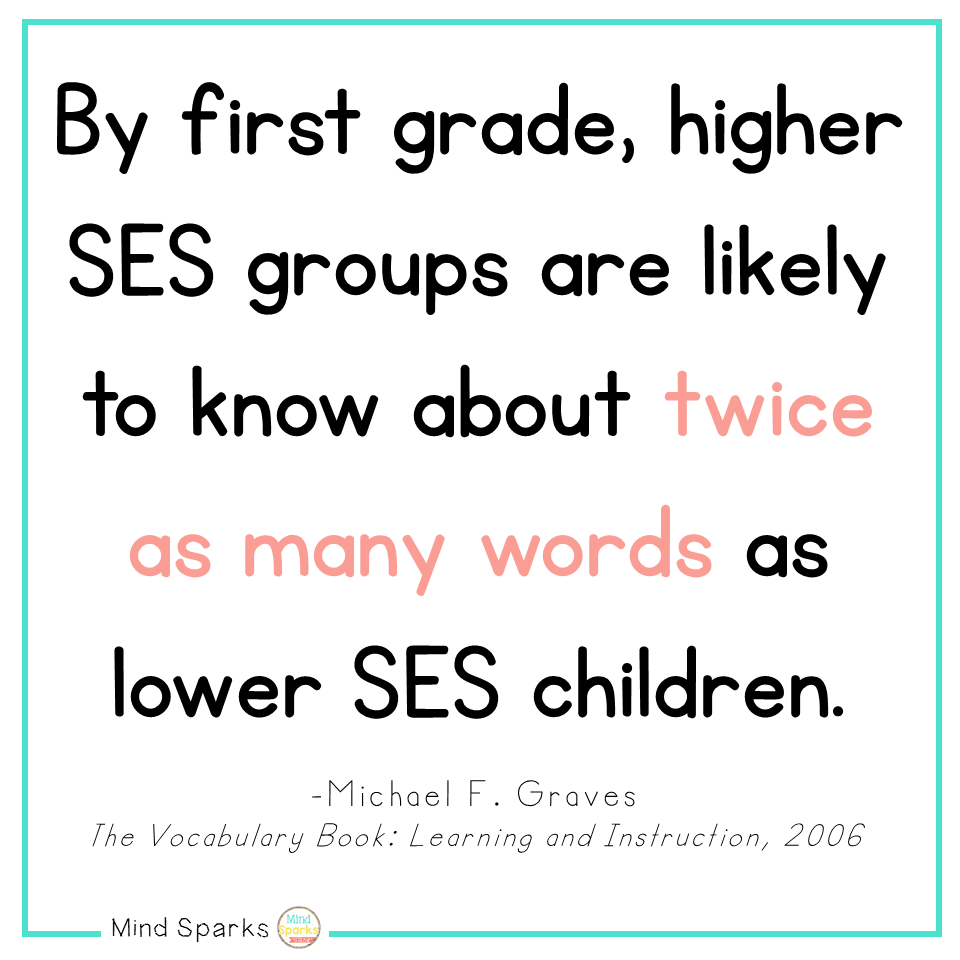
However, students who come from a "language poor" environment have a greater chance that reading will be difficult for them.  Some children will come to school already suffering from word poverty.  These kids will know fewer words, simply because the environment they grew up in was not a talkative one.  

The graph below shows how the gap in word knowledge grows when a student enters school. This study was conducted by Andrew Biemiller, professor at the University of Toronto.  As you can see students who enter school with average to advanced word knowledge acquire a vocabulary more quickly and easier than those who enter school less vocabulary adept. 

Why might coming from a talkative home matter?  Well it is proven that children with better vocabularies learn to read more easily than those with a limited vocabulary (Metsala, 1999) 


Adults can facilitate the process of word learning when they do the following things: 


1. Introduce new words

Teach your children new words. You can do this by using children's literature, or by simply telling them a word and explaining it.  During the explanation, make sure you give a kid-friendly definition.  You can also increase their understanding by giving synonyms, antonyms and showing images of the word.

For example: A parent  is reading a non-fiction book about sharks to her son.  She reads the word, "predator" in a sentence and then stops to define the word to her child.  She says, "A predator is an animal that gets food by hunting other animals.  Bears are predators.  Lions are predators. The opposite of a predator is prey." 


2. Elaborate on what a child has said

As you converse with your child, extend their thinking.  Ask them to explain their thoughts by using open ended questions.  After your child has finished verbalizing their thoughts, tell a similar story or add additional details to what they have said. 

For example: When a child talks about their day at school,  a parent could ask: I wonder why?  What might you do differently next time?  How did you..."  Check out this list of open ended questions you could ask to get your child thinking and talking from Parents Magazine. 


3. Confirm and clarify a child's attempt to use new words

If a child uses a word correctly, congratulate them.  Encourage them to compare or contrast words, or even act out or show the word they used.  If  you child uses a word incorrectly, validate their desire to use precise vocabulary and then interject with the word that should have been used.  Then invite your child to repeat the word and try to use it in the right context.

For example: You said the krill was a predator in the story, but I think you meant the krill was prey.  I am so proud of you for using precise vocabulary, but predator means an animal that hunts weaker animals and prey means animals that are vulnerable to being hunted by stronger animals.  Do you want to try using predator in a sentence?  


4. Use unusual words in conversation  

I sometimes refer to unusual words as, "ten dollar words."  These words are precise, descriptive and uncommon. Use these "ten dollar" words over and over again, until your child starts incorporating these words as apart of their everyday vocabulary. 

For example: Wow!  Your dominoes just collapsedCollapse means to fall over. 


Check out this video published on Reading Rockets, in which Dr. Rebecca Silverman gives great examples on what parents can do to help build vocabulary with their children


November 14, 2016

Quick Draw (A GREAT game to review vocabulary!)

Where do the weekends go? I swear I blink and the weekend is gone.

Anyway....I wanted to share an extremely easy, no prep and engaging game you can play with your students.  I call it quick draw!


So--the title isn't the greatest---but trust me the kids will LOVE the game! 

Basically quick draw is a game to review or introduce vocabulary terms, words on a word wall or even spelling words.  

Quick draw requires virtually no prep and the materials needed are in almost every classroom.  

Doesn't this sound like a great game--huh?  No prep.  No materials. AND fun??

Anyway.....

Here's how you play:
  1. Determine the list of words you want to introduce or review
  2. Provide each student with a marker board
  3. Provide each student with a dry erase marker 
  4. Shout (okay maybe not shout...but say) the word aloud to students
  5. Give students 30 seconds to illustrate the word
  6. Say, "3.....2.....1....show me!" and every student MUST hold up their illustration (if they are still drawing I give them a warning, and tell them they get paper pencil next time)
  7. Select a couple of students to explain their drawing to the class
It really is a great game!!  I played it with my whole class when I taught fourth grade, but I also play it with my small groups for intervention time. Pictured below is Quick Draw in action......


If you want to download the "cute directions" on how to play this game....you can download it for free from my google drive, by clicking below :).


Hope you all are having or had a great day! :)

January 19, 2015

Freebie Linky Party

Well, in case you were worried,  I survived my inservice......

Scratch that.

I BARELY survived today's inservice.

It's not that teacher inservice is terrible---I mean I actually learn quite a bit.  The part that is terrible is the feeling you have after the training day is over.

I literally cannot shut down my  brain. I just keep thinking, reflecting, thinking, reflecting and thinking!  There are so many ideas I want to try.  I have so much to share with colleagues.  I have so much to teach my students.....

So I choose to binge eat chocolate and Twizzlers.  That's how I am dealing. Ha!

Anywhoo......today I am linking up with StudentSavy for her linky party!  StudentSavy's party is all about freebies---so visit her blog and snatch up lots of great resources!


The freebie I am providing is my Vocabulary Rock & Roll page!  It is perfect way for students to review previously taught academic terms!  This resource can be used as an individual, collaborative or whole class assignment--all you need is paper, dice and academic language!

Enjoy!


April 16, 2013

Flash Fluency

Being a successful reader is comprised of multiple things---fluency being one of them! If a child is trying to read from point a to point b and decodes every word in between ....I can guarantee that child didn't retain a thing!  Thus---fluency is important!!  Ideally, for older students reading should be automatic.  AND--when older students encounter a word they are unfamiliar with (which they will), they should have word attack strategies to decode the word.........

Now, unfortunately, we don't live in a perfect world; which means we do have struggling older readers (if you don't, I want to know where you work, haha!).  One great way to help struggling readers, is to help them become more fluent with their reading. 

By fluent-- I mean for the students to become more automatic (not prosody or expression--that is for another post another day).  There are several ways to make students become automatic with their reading.

1. Practice Dolch sight words
  • Dolch sight words are 220 words which students should not sound out--but simply know by sight. 

2. Practice Fry's 1,000 high frequency words
  • Dr. Edward Fry compiled a list of the most frequently used words students would encounter while reading. The 1,000 words are divided into lists of 100--which start out easy and get harder. 

3. Practice with Flash Fluency
  • Flash Fluency was developed by The Positive Engagement Project, which did a plethora of  scientific research to create four "no excuse" word lists
    • Tide Pool
      • For early readers
      • 50 sight words from Dolch and Fry
    • Low Tide
      • One step above early readers
      • 150 sight words form Dolch and Fry
      • No repeat words
    • High Tide
      • Grade 2
      • 600 sight words and academic vocabulary
      • No repeat words
    • Tidal Wave
      • Grades 3 and up
      • 1,000 words
      • Sight words and academic vocabulary
      • No repeat words

I have heard of Dolch and Fry words---but Flash Fluency words are new to me.  I love Dolch and Fry; and mastering the words does make a huge difference in a child's fluency. However I am intrigued by the whole Flash Fluency program.  I think it is great how the lists don't just include sight words, but also academic vocabulary. Also, the word lists go all the way up to sixth grade--which is awesome because many sight word lists don't stretch that high.

Anyway---click the links above and check out the lists for you and your students. You can download the PDF's for free. Included in the download are word lists, assessments, implementation ideas and fun ways to practice.

Let me know what you think!
Katie