It is almost here--TPT's Special Spring Sale! Whoop Whoop!
It is a great time to treat yourself and purchase those items off your wish-lists! Teachers Pay Teacher's two-day-only sale starts Tuesday, April 6th at 12:01am and runs until Wednesday, April 7th. Most items are 20% off, but buyers can receive an additional 5% when they enter code "FORYOU21" at checkout.
You have plenty of time before the sale---so, hop on over to TPT and start adding items to your cart so you are ready to checkout on sale day!
Last time we were together we took a moment to truly understand the meaning of heart words. Not sure what a heart word is? Click here to read the previous post in this series High Frequency Words Part 2: Heart Words.
Furthermore, if you want to know the difference between sight words and high frequency words, click here. This will take you to the first post in the High Frequency Words series: High Frequency Words What Are They?
For now we are going to spend some time on making those tricky high frequency words sticky for kids!
Follow the steps below to help kids master heart words. AND...if you haven't already checked out Linda Farrell's model for teaching heart words, I highly recommend it. You can find it by going to Readster's website, or by clicking here.
Step 1: Teach the phonetically regular part of the word (To make these tricky words not so overwhelming, fold heart words in with regular phonics instruction based on the pattern you are teaching. For example they and their can be introduced when teaching the digraph /th/.
Step 2: Point out the part of the word that makes the word a heart word--the part that is not phonetically spelled correctly. In following example, the teacher would make sure to put a heart above the e in the word "the" since the e doesn't do what it is supposed to. It is really important that the teacher spends some time dialoging with students about why she/he is placing a heart there. There is no need to place a heart above the digraph th because the th is doing what it is supposed to do.
Step 3: Use multisensory techniques to reinforce these tricky words. Some multi-sensory options are sky writing, arm tapping, rainbow writing or finger writing in sand, shaving cream, sugar or on a bumpy surface, etc. The chart below names and describes some easy and effective multisensory techniques teachers can use with heart words. Most involve little prep! Click the link at the bottom of this post and grab the PDF of these techniques for free! :)
It isn't necessary to use multi-sensory techniques with regularly spelled high frequency words....just the heart words. Adding multi-modal to these irregularly spelled words helps our brains remember and map the words. The words that aren't irregularly spelled don't need multi-sensory techniques as all of the letters do what they are supposed to. If a student is struggling with reading a regular high frequency word prompt him or her to remember the sounds the letter(s) make.
Step 4: Give students lots of exposure to these tricky words! Read aloud and independent reading is a great time to point out some of these words, or pre-teach them.
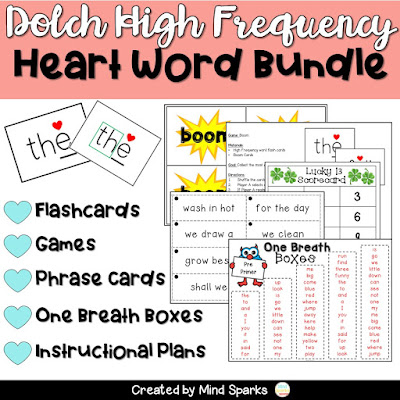
If you are looking for a great resource to get these tricky words mastered, check out the resource below! This heart word bundle has everything from flashcards to games! Low prep and super engaging! Whoop!
In part one of High Frequency Words I wrote about the difference between high frequency words and sight words. If you don't know the difference--I highly encourage you to check out the first post by clicking here.
For this post we will focus on irregularly spelled high frequency words--or as many leading reading researchers call them heart words.
First, let's make sure we understand the definition. Heart words are high frequency words that have some part of their word irregularly spelled. We need to know these words by heart because they show up frequently in text and are used often while writing. If we know them by heart, than we can read and spell them automatically.
Lets look at some examples of heart words below. In the word "the" the /th/ sound matches how it is supposed to be spelled, yet the "e" makes the schwa sound when it really should say its long sound. This word is heart word because part of it is spelled irregularly. A heart is placed on top of the "e" to signify that is the part of the word that is not following a pattern. It is always important to point out to students the parts that do follow a phonics pattern, and the parts that don't.
In the word "from," the /f/ /r/ and /m/ sounds match the correct grapheme, yet the "o" makes a short u sound instead of a short o sound. This word is a heart word because it has an irregularity in terms of how it is spelled.
In the Dolch high frequency word list, 82 of the words would be considered heart words. That is 37% of the list. These 82 (plus an additional 14) words are shown below in a table from Readsters and their publication of A New Model for Teaching High Frequency Words. Readsters grouped these heart words based on similar spelling patterns.
Our job as teachers is to make these tricky heart words not so tricky. We need to make the tricky sticky! So, please join me for the next post in this series: how to help kids master heart words!
Do you know the difference between the term high frequency word and sight word? Maybe you didn't know they were different terms...but they are. There IS a difference..... a BIG difference.
Often times teachers use these two words interchangeably. Or, teachers use the term "sight word" but what they are really describing is a "high frequency word."
No worries....I am here to set the record straight! And...if you don't know the difference, that's okay! Many of us weren't ever taught the correct definitions and the terms. It isn't as though we want to use the wrong words, they have just never been clearly defined for us. BUT..... after this post you will know. And...when we know better, we do better!
So, lets set the record straight!
High frequency words are words that appear often in text. Edward William Dolch and Dr. Edward Fry both complied two separate lists of words that are commonly used in the English language.
Dolch published his list of 220 words in 1936. His list did not originally contain any nouns, but a later addition added 95 nouns to the list. Dolch's word list is based off of words that students in kindergarten or second grade would typically be reading. The words are usually listed by age group.
Fry improved upon Dolch's list and published 1000 words in 1957 that included all parts of speech. These words were based on the "American Heritage Word Frequency Book " which ranked how often words occurred in reading material for grades 3-9. The Fry list was updated in 1980. Fry's list is often segmented into groups of 100.
It is important to note that these high frequency word lists were created during the whole word movement, and we know that whole word reading is NOT the correct way to teach reading. Students need explicit and systematic phonics instruction in order to crack the code written language. With that being said, we still need to teach these words as many of them are used in decodable readers to help make meaningful sentences. BUT (and it is a BIG BUT) we need to teach these high frequency words explicitly! Please take the time to read A New Model for Teaching High Frequency Words from Reading Rockets on the correct way to teach high frequency words. It is an AMAZING read! The video below is a quick view (2 minutes) on how to teach an irregular high frequency--definitely worth the watch.
Sight words are words that are instantly and effortlessly recognized by a reader. The official name for sight words is called the "orthographic lexicon." Any word can be a sight word for a student, as long as it has been mapped by the reader.
So, what does it mean for a word to be mapped?
First we must understand that orthographic mapping is a mental process for later instant and effortless retrieval. Orthographic mapping is a mechanism that builds our sight vocabulary.
So, how do we map words?
Phonics is the foundation for mapping. Once students have been explicitly taught alphabetic principle (connecting letters to their sounds) and phonics concepts they are able to decode a word. When students are decoding a word, orthographic connections are formed. Students are anchoring a word they have heard spoken, to the written letter sequences at the phoneme (sound) grapheme (print) level.
In a nutshell--oral language is huge. Phonics needs to be taught explicitly and systematically and kids need to read decodables.
If you are interested in watching an expert explain orthographic mapping, check out this video from the one and only David Kilpatrick!!
Gosh, I hope that cleared some things up! :) Please stay tuned for future posts about high frequency words.....because there is a lot to cover. :)
Part 1: High frequency words vs. sight words
Part 2: Irregular words or "heart words"
Part 3: How to master irregular high frequency words
As I was writing All About Word Worts blog series, I was also working through LETRS training. One of the modules in LETRS focuses on word study. The timing of this module was perfect --as it coincided with the exact moment I was writing the blog series!
As I was reading through the module, I had many confirmations. Many of the effective, research based strategies mentioned in LETRS were the same as I had written about. Phew!
BUT...I had one major A-HA!
Dr. Moats and Dr. Tolman encouraged connecting words used in a word sort back to meaning. Whaaaaaat! I had never thought of that before--but it makes TOTAL sense!
I had always understood the point of word sorts to be additional (and application) of taught phonics skills with decoding, encoding and discovering word patterns.....but had never thought about adding a meaning component to it. Wow! Love it! Mind blown!
Research tells us that the more students learn about the structure of words, they better they will read them independently, the more readily they will process their meanings and the more they will understand and remember about their spelling. In other words....knowing a word well requires us to be able to identify all of the aspects of language present in the printed word. We need to know the words meaningful parts, syllables, graphemes AND phonemes.
So how do you add a meaning layer to your word sort? It is as simple as asking a few meaning based questions after students have completed their sort. Have students look at their completed sorts, and ask them some questions about the words they are looking at.
For example:
1. Which word means ______?
2. Find two words that rhyme.
3. Which words are things you can eat?
4. Which word is a synonym for_____?
5. Which word is an antonym for _____?
6. Which one is a animal?
7. Find a word that is a verb.
8. Find a word that is a noun.
9. Find a word that is an adjective, etc.
10. What is something you write with?
The list of possible questions you can ask are endless! I wouldn't go overboard on questions.....just 5-10 to add in a meaning component.
How great is that tip?!?!
It would be easy to modify the questions by having students locate a particular row. Example: in your /sh/ column find a word that _____.
Side note: If you are passionate about effective literacy instruction--LETRS training is a must! LETRS (Language Essentials for Teachers of Reading and Spelling) was developed by renowned literacy experts Dr. Louisa Moats and Dr. Carol Tolman which provides Prek-5th grade teachers with the research, depth of knowledge and skills to improve literacy and language development of all students. A small group of educators in my district has been working through the first four units together, and I have learned quite a bit. I love how the professional development series provides in-depth explanations in a digestible way, AND also gives examples of application in the classroom. Check out this quick video below if sounds like something you (or your colleagues) might be interested in.
It is almost here--TPT's February Sale! Whoop Whoop!
It is a great time to treat yourself and purchase those items off your wishlists! Teachers Pay Teacher's two-day-only sale starts Tuesday, February 9th at 12:01am and runs until Wednesday, February 10th. Most items are 20% off, but buyers can receive an additional 5% when they enter code "FEBSALE21" at checkout.
Many sellers have spent hours adapting their printable resources into something that can be used digitally. Also many sellers have poured time and energy into creating resources perfect for remote/distance learning. Now is a perfect time to stock up and save on resources you have been eyeing!
I hope everyone has a chance to take advantage of the two-day-only sale!