Home Meet the Blogger Freebies Contact TeachersPayTeachers BlogLovin Instagram Pinterest Facebook Twitter Image Map

May 4, 2023

Top 5 Mistakes Teachers Make Teaching Vocabulary


Teaching vocabulary can be tricky!  Most of us never took a class in college which covered effective reading instruction...AND as elementary teachers we have more than just one subject to devote our time to studying. 

Some teachers may just be winging the whole "vocabulary thing,"  Teachers are simply doing the best they can with the tools they have in their toolkit.  So, it seems reasonable that we might be making a few mistakes.  The good news---common mistakes are easy to fix!  

Keep reading to find out the top 5 mistakes teachers make with vocabulary, AND what you can do to fix those mistakes!


1. Not teaching vocabulary

When someone doesn't feel efficacious about something, or see the benefit....sometimes it gets skipped or pushed to the "I'll just do this later list."  Vocabulary instruction is NOT something that should be skipped.  

Research supports that teachers should be directly teaching 3-5 words per text selection!  This means students should be adding 2,000 to 3,000 new words per year to their reading vocabularies. (Beck, McKeown & Kucan, 2002).  Check out A Routine for Explicit Vocabulary Instruction for how to directly teach a term. 


2. Not explicitly and directly teaching words


We learn vocabulary in two ways, incidentally and and intentionally.  Incidental learning is when children are indirectly exposed to words.  Indirect exposure to words happens when students engage in oral language experiences (talking with friends, adults, siblings, etc.), listening to books being read and independently reading.  Most of our vocabulary is acquired incidentally, however this cannot be the only way we learn new terms!

Intentional learning of words happens through direct and explicit instruction.  As mentioned above, research supports teachers directly teaching 3-5 words per text selection, and getting students to truly own a word.  This means students students should explicitly taught some 400 words per year in school (Beck, McKeown & Kucan, 2002).  

To truly own a word, students must be able to pronounce the word, understand its meaning and use it during conversation or in writing.  Check out A Routine for Explicit Vocabulary Instruction for how to directly teach a term! 


3. Not illustrating connections to other words


Our brains crave organization and patterning.  As we learn words, our brains are creating pathways to connect new words with known words. Every word in your mental dictionary is connected to other words, ideas or images.   

Help students truly understand a vocabulary term by facilitating connections.  Some great classification activities include the following:
  • Open sorts--give students a group of words and have them group the words how they see fit.  
  • Identification of categories--show students a group of words that go together and have them determine a category label.
Check out this free one-pager resource which includes 12 different ways you can have students sort and classify words!  A list of words can be compiled based on a spelling pattern, phonics skill, vocabulary or grammar concept!  


4. Not providing ample opportunities to use newly learned terms


One principle of effective vocabulary instruction is providing multiple exposures to a word and it's meaning.  There is great improvement in vocabulary when students encounter vocabulary words often (National Reading Panel, 2000).  Students have to see a word multiple times, and in multiple contexts to truly own the word.

Check out Resources to Teach Vocabulary for oodles of ideas on how to provide students with multiple opportunities to interact with vocabulary terms.  


5. Not selecting the right words to teach


Determining which words to teach our students can be tricky.  There are just SO. MANY. WORDS!

Leading literacy experts (e.g. Archer & Hughes, Beck, Graves, Stahl & Nagy) all agree on the following five rules when selecting vocabulary to explicitly teach.

  1. Choose words students probably don't know
  2. Choose words that are crucial for text understanding
  3. Choose words that students will encounter often
  4. Teach words that are difficult to learn without explicit instruction
  5. Select 3-5 words for each text.
If you are looking for more information on how to best select vocabulary words to explicitly teach, check Choosing Words to Teach by Isabel Beck, Margaret McKeown and Linda Kucan published on Reading Rocket's website.  These ladies are the true guru's of teaching vocabulary!


April 23, 2023

Resources to Teach Vocabulary

Increasing a student's vocabulary is important, as vocabulary knowledge has a direct correlation to comprehension.  

When we carefully select words and then explicitly teach students those word meanings, we are helping students create a deep understanding of words.  Vocabulary instruction is imperative for all kids, but vital for students who have under developed vocabularies.


In 5 Ways to Practice Vocabulary Effectively, I provided 5 ways teachers can have students interact with vocabulary terms that will facilitate word connections.  Lets take a look at resources you might be able to use for each of those steps! 


1. Multiple Meanings


Did you know there are 5,000 or so common words in English that have multiple meanings!  Crazy, right? 

Simple word maps are an easy way to help students see multiple meanings words can have.  A word map can be as simple as the one pictured below--a circle with a target term in the middle, and connected circles that represent the multiple meanings.    

If you are working with more advanced readers and need a word map with more rigor, check out the map below.  This map has students expanding their understanding by using vocabulary terms in a sentence, writing a definition and drawing a picture.  


2. Classify Words into Categories


Our brains crave organization and patterning.  As we learn new words our brains create pathways to connect new words with known words.  To help my students develop those pathways, I use word sorts!  I LOVE word sorts, and students do too!!

Check out this free one-pager resource which includes 12 different ways you can have students sort and classify words!  A list of words can be compiled based on a spelling pattern, phonics skill, vocabulary or grammar concept!


Are you in need of pre-made word sorts?  Maybe you simply don't have the time (or energy...I feel ya) to create your own.   

Look no further....I have oodles of them! Just click the images below!


3. Analyze Semantic Features


Semantic feature analysis is a strategy to compare characteristics of words.  Many words have some in common properties, and identifying those helps students create word networks.

Check out the Semantic Feature Analysis from Reading Rockets.  This article takes a deeper dive into analyzing characteristics of words, and you can download a free semantic feature analysis grid!!


4. Use Antonyms & Synonyms 


Anytime you help students gain a deeper meaning of a vocabulary term ...it is a win!  Use a vocabulary graphic organizer  (like the one pictured below) to assist students in clarifying their understanding about new words.

Most vocabulary word maps will include synonyms, antonyms and a space to list characteristics. 


Check out this game version of a word map, Vocabulary Rock and Roll !  Just print this sheet for students and let them play!  


Building students' vocabularies takes TIME and many, many, many encounters with words!  Incorporating any of the above strategies and resources into your daily routine will get your students on the path to being word masters!!


April 14, 2023

Test Motivation for Students

  Standardized testing season is upon us again.....


I have a love/hate relationship with testing.  I loathe the pressure that students and teachers might feel, but I also love celebrating the academic gains students make.

Like many in education, I don't believe a singular test score defines a student.  However, I do believe we need data on students to determine what needs the student may have.  Test scores also give us data on school and curriculum performance.  

Is the curriculum addressing the standards?  

Is the curriculum rigorous enough?  

Do we have areas we need to supplement?  

Is effective instruction being provided?      

Test scores help us ensure that students are being served, and that tax payers are getting a good return on their investment.  

With that being said, I also want to make sure students don't feel stress yet are motivated to perform at their best. To ease testing anxiety, and give my kiddos a little extra encouragement I surprise them with a fun treat whenever we have an assessment.


The gesture isn't much, but it sure makes the students smile. AND...one smile is worth it...right?!?

Additionally, the younger grades in my building "adopt" an older grade.  The younger students write positive notes to each student, draw them pictures and decorate the classroom with motivational posters!  

Check out this list of motivational ideas from Engage to Learn. Dr. Luz Martinez, an associate superintendent at Midland ISD in Texas with 25 years of experience in education, shares a list of over 15 ways to motivate students before AND after high stakes testing. 

If you are interested in lifting your kids up a little extra during testing season, check out these treat tags on TPT.  For under three dollars you get FIFTEEN different sayings!  


Best of luck during this testing season! 

March 31, 2023

5 Ways to Practice Vocabulary Effectively

After a word is explicitly taught, students need MULTIPLE exposures of the word in order to "own" it.  These encounters should be intentional, spread out and reviewed frequently.  

The best way to provide ownership of a word is by learning words in relation to other words. 


Our brain loves patterns, so it likes to organize our mental dictionary by building connections among words that are learned.  Our brain creates networks of words that have similar features like the ones listed below:

  • phonological
  • semantic
  • morphological 
  • orthographic 
  • visual
  • emotional


So, how do you help the brain create word networks? Listed below are five ways to effectively practice vocabulary that facilitates word connections.  


1. Multiple Meanings


Does the vocabulary word you are teaching have multiple meanings? If so--point that out!  Did you know out of the 5,000 or so most common words in English, many of them have multiple meanings.  Therefore, lots of opportunities will present themselves to dialogue about the multiple meanings. 

Example: hit, jam, check, frame, etc. 

A simple word map (pictured below) helps students see the multiple meanings a word can have.


2. Classify Words into Categories


As I mentioned before, our brains crave organization and patterning.  As we learn words, our brains are creating pathways to connect new words with known words. Every word in your mental dictionary is connected to other words, ideas or images. 

Help students truly understand a vocabulary term by facilitating connections.  Some great classification activities include the following:
  • Open sorts--give students a group of words and have them group the words how they see fit.  
  • Identification of categories--show students a group of words that go together and have them determine a category label.

3. Analyze Semantic Features


Semantic feature analysis is a strategy to compare characteristics of words.  Many words have some in-common properties and identifying these properties helps students create those ever important word networks!  When we help students connect one word to an already known word, we deepen their understanding of the term.

Semantic feature analysis can be done with a simple chart as pictured below:


Check out Semantic Feature Analysis from Reading Rockets.  This article takes a deeper dive into analyzing characteristics of words, and you can even download a free semantic feature analysis grid!!


4. Use Antonyms


Antonyms are words of opposite meanings.  Identifying antonyms of vocabulary terms deepens a student's understanding of the word.  This is one more way to teach words in relation to other words. 


5. Use Synonyms 


Synonyms are words with the same meanings.  Identifying synonyms for vocabulary terms helps students create relationships in meaning among the words.  There is often a shade of meaning that distinguishes one synonym from another---making one word a better choice than another.  Again--the point is that you are facilitating the creation of "word networks" for  students.  AND....our brains LOVE word networks! 

If you are looking for more strategies on vocabulary instruction, check out Reading 101: A Guide to Teaching Reading and Writing from Reading Rockets. This article has tons of great tips and instructional strategies!


March 18, 2023

🌷 Books to Celebrate Spring 🌷

 Where ya' at warmer weather?!?

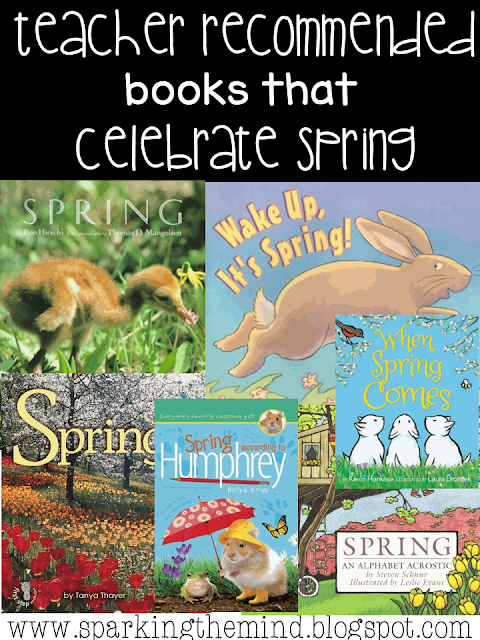
Now, chilly temperatures are my jam.....but after a few months of sub-zero temps and lots of indoor recess time...I am ready for spring! Check out the following six books, which will make perfect read alouds to honor the longer, warmer and recess outside days ahead!


It is important to note that a few of these books may be out of print, yet are widely available at public libraries or on websites like, Thriftbooks.  AND...who doesn't love a public library or an inexpensive book?    


Spring by Ron Hirschi (PreK-2)

Great photographs and text introduce students to the natural world of spring. Hirschi, who has a degree in wildlife ecology and first worked as a biologist, has written many books for children on the topic of animals, natural habitats, discovering Earth and wildlife seasons. 


Spring by Tanya Thayer (Prek-2)

Colorful photographs and easy to understand text provide readers with a basic overview of the spring season.  Readers will be introduced to the idea o how animals, plants and people adapt to seasons.


Spring: An Alphabet Acrostic by Steven Schnur (Prek-3)

This is a companion book to "Autumn: An Alphabet Acrostic," where students will delight in the pleasures of spring in twenty-six short poems.  Schur uses rich vocabulary that will bring the spring season to life--especially with Leslie' Evans's linoleum-cut illustrations.  When the poems are read vertically, each poem reveals a playful acrostic--making this book a double treat for kids!    


Spring According to Humphrey by Betty Birney (Prek-2)

This is the twelfth book in the award winning school hamster series. Spring has sprung and everyone at Longfellow School is happy, including Ms. Brisbane's class!  Family Fun night is right around the corner...which adds to the excitement for many students, except Humphrey.  Humphrey wonders (and worries) about his own family.  This story will take you on a journey with Humphrey as he realizes spring comes with lots of new things that grow and change, just like his family.   


Wake Up, It's Spring! by Lisa Campbell Ernst (Prek-2)

Ernst uses playful words and pictures that match the cheeriness of the spring season.  Word of the arrival of spring begins with the Earth telling a little worm.  The happy gossip of spring's arrival travels fast, and before long everyone is celebrating the arrival of spring! 


When Spring Comes by Kevin Henkes (Prek-2)

Everyone loves a book by the award-winning, bestselling husband and wife team of Kevin Henkes and Laura Dronzek! Henkes uses striking imagery, repetition and alliteration to get readers to really feel, smell and taste spring.  Dronzek's gorgeous paintings show the transformation of the quiet, cold winter to the joyful newborn spring. 


For more books to celebrate spring check out this list from We are Teachers  or PBS Kids!

March 10, 2023

Spring Break Bucket List (for Teachers!!)

How ready are you for spring break?  Teaching is such a taxing and exhausting (yet rewarding) occupation.  When teachers FINALLY arrive at a long break....They. Are. Ready! 


All too often spring break seems to quickly slip through our fingers, and we arrive at the end of our week wonder how it arrived so quickly.  Breaks are elusive little things, aren't they? 

In order to take full advantage of your time off, I urge you to make a Spring Break Bucket List for yourself!  Bucket lists are a great ways to ensure that relaxation, fun and meaningful moments happen.

 By the end of break I want to look back on the the two weeks and have something to show for it---and I want that for you too!  


Click the image below to download this free resource!  Included in the download are multiple bucket list bingo boards.  There are two pre-filled bucket boards with lots of fun options!  You don't even have to think of your own fun--just print and start enjoying life.  Ha!  

There are also two boards that are mostly filled, but with a few blank spaces.  The mostly filled option is great if you have a few of your own ideas you want to insert! Last, there is  a completely blank board for those of you who have a brain swimming with fun ideas!


I truly hope you find this Spring Break Bucket List for teachers helpful and that you have an opportunity in these next few weeks to take time for yourself.  Spring break is the perfect time to slow down, take a deep breath and breathe fresh perspective into your life. 

 It is SO IMPORTANT that you fill your cup, so that you are ready to tackle the rest of the school year.  Remember that self care doesn't mean me first, it just means me too! 


February 4, 2023

❤️ Classroom Valentine Treats for Kids! ❤️

 Valentine's day is almost here!!   

This means...I need to get treats ready for my sweet kiddos at school!

I don't know if I have met a teacher who doesn't want to buy a valentine gift for each of his or her students--but with classes of 20+ kids......it just gets too darn expensive!

As a reading interventionist, I service around 60 students, so I am always on the hunt for something festive and inexpensive. Thus....I use treat tags! Treat tags are a wonderful option--simple, relatively low cost and fun! 


I print out the treat tag and simply staple the tag to a ziplock bag with treats and pass them out to students during my classes. Easy Peasy!


OR...if I am feeling a little sneaky I fasten the tag with tape (or put it the tag and treat in a bag) and sneak them into back-packs for a fun surprise when my little love bugs get home.


Sometimes  I am in that extra-teacher-tired-teacher mode and I just lay treat tags and goodies on student desks before they come to my classroom.   


Looking for ideas of some simple games to play during Valentine class parties?  Check out this list of 14 games from The Spruce.  How about kid-approved games?  Check out this list from Teach Hub.

Interested in treat tags for your students? Check out these treat tags on TPT . For under three dollars, you get FOURTEEN options for festive fun!


Happy Valentine's Day!